BMW E30 Rust Guide: Where to Look Before You Buy or Sell

Updated: 4 days ago

Rust is one of the biggest factors separating a solid BMW E30 from a project that can quickly become much larger than expected. That is especially true in New England, where decades of winter road salt, moisture, snow, and seasonal storage can leave an otherwise complete-looking E30 with corrosion hiding underneath.
The good news is that E30 rust tends to show up in recognizable places. You do not need to be a body-shop expert to perform a useful first inspection. Knowing where to look can help a buyer avoid surprises, help a seller describe a car accurately, and help an owner decide whether a neglected BMW is worth restoring, selling complete, or using as a donor car.
Why Rust Matters So Much on an E30
Mechanical problems are often easier to price than body corrosion. Engines, transmissions, suspension parts, brakes, and many service items can be repaired or replaced. Structural rust can require cutting, fabrication, welding, paintwork, and extensive disassembly before a car is safe or presentable again.
That does not mean a rusty E30 has no value. Complete project cars and parts cars can still contain desirable drivetrains, interiors, trim, glass, electronics, body panels, and factory equipment. It simply means the location and severity of the rust matter as much as whether the engine currently runs.
1. Front Floor Pans and Jacking Areas

Start low. Inspect the front floor areas from both inside and underneath the car. Pay close attention near the factory lifting points, seams, and areas where undercoating has cracked or separated. Moisture can become trapped beneath damaged undercoating and allow corrosion to spread before it is obvious from above.
Inside the car, lift or press on the carpet if possible and look for dampness, staining, soft spots, or evidence of previous patches. A dry-looking carpet does not guarantee the metal below it is solid.
2. Rocker Panels and Pinch Seams

The rocker panels run along the lower sides of the car beneath the doors. On a New England E30, inspect the visible outer rocker, the lower seams, and the areas surrounding the lifting points. Bubbling paint can be the first visible sign, but significant corrosion may also hide behind trim or under thick coating.
Look for crushed or distorted seams from improper jacking. Once the coating is damaged, those areas can become entry points for moisture and salt.
3. Front Fenders and the Area Behind Them

The lower rear portion of the front fenders is a common place for dirt and moisture to collect. Check the bottom of each fender near the rocker and inspect the wheel-well side where possible. Surface bubbling on the outside may be only the visible portion of a larger problem behind the panel.
Front fenders are bolt-on panels, so rust here is usually less alarming than corrosion in the structure behind them. The important question is whether the rust stops with the fender.
4. Wheel Arches and Rear Quarter Panels
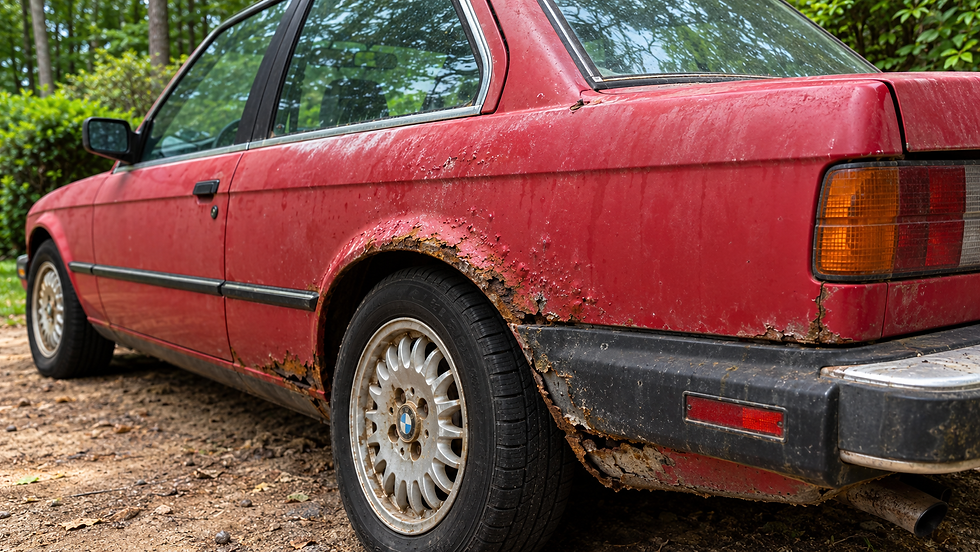
Run your eyes and hands around the wheel-arch lips. Look for swelling, bubbling paint, cracking seam sealer, and previous repairs. Rear-quarter corrosion deserves more attention than a rusty bolt-on front fender because the rear quarter is part of the body shell and is more involved to repair correctly.
Inspect both the outer arch and the inner wheel housing. A clean exterior lip can still hide corrosion on the back side.
5. Battery Tray and Trunk Corners

Open the trunk and remove loose items so you can see the floor. Check the battery area, side wells, seams, spare-tire well, and the lower corners of the trunk. Battery leakage, failed seals, and water intrusion can all contribute to corrosion here.
Also look for standing water, mildew, discolored carpet, or fresh seam sealer. Those clues do not automatically mean there is major rust, but they are reasons to inspect more closely.
6. Rear Valance and License-Plate Area

Inspect the rear valance below the bumper and around seams, mounting points, and the license-plate area. Cars that have lived through many northeastern winters can collect road debris and moisture at the rear of the shell. Collision repairs can also make these areas more vulnerable if coatings and seams were not restored properly.
7. Windshield, Cowl, and Sunroof Drain Areas

Rust around glass can begin as a small bubble and eventually become a leak. Look around the windshield seal, lower windshield corners, cowl, and roof openings. On sunroof-equipped cars, water-management problems can lead to damp interiors and corrosion away from the obvious source.
If the headliner, A-pillars, carpet, or footwells show water staining, investigate before assuming the issue is only a worn seal.
8. Suspension and Subframe Mounting Areas

This is where cosmetic rust becomes a safety issue. Inspect the metal around suspension mounting points, rear subframe areas, spring perches, and other structural attachment points. Heavy scaling, perforation, cracking, or poorly executed patches in these areas should be evaluated carefully before the car is driven.
Surface Rust vs. Serious Rust

Not every brown spot is a reason to walk away from an E30. Light surface corrosion on replaceable brackets or exposed hardware is very different from perforation in a floor, rocker, wheel housing, or mounting point.
As a simple rule, ask three questions: Is the rust structural? Has it gone through the metal? And how much of the car must be disassembled to repair it correctly? The more often the answer is yes or a lot, the more heavily rust should affect the value of the project.
Signs of Previous Rust Repair
Older E30s often have previous bodywork, and previous repair is not automatically bad. What matters is how it was done. Look for mismatched undercoating, thick seam sealer, obvious welded plates, uneven paint texture, overspray, unusual body seams, or areas that look much newer than the surrounding metal.
A properly cut, welded, sealed, and refinished repair can extend the life of a car. A plate placed over untreated corrosion may only hide the problem temporarily.
How to Photograph Rust When Selling an E30
If you are selling a project E30, clear rust photos usually help more than vague descriptions. Photograph the problem area from far enough away to show its location, then take a close-up that shows the actual corrosion. Include the floors, rockers, wheel arches, trunk, and underside if they are accessible.
Do not worry about making a project car look perfect. For an enthusiast buyer, accurate photos make it easier to understand what the car is and what it may need.
For more tips on how to properly photograph your BMW for resale check out our other guide:
Does Rust Make an E30 Worthless?
No. Rust changes the equation, but it does not automatically erase the value of the car. A rusty E30 may still be a worthwhile restoration candidate if it is desirable and sufficiently complete. Another car may make more sense as a donor because the shell needs more repair than the finished vehicle would justify.
Even heavily rusted cars can contain valuable original components that are increasingly difficult to replace. Before scrapping an E30, it is worth identifying the model, drivetrain, factory equipment, interior, body style, and usable parts.
A New England E30 Deserves a Careful Inspection
The E30 is now old enough that condition matters far more than a quick glance at mileage or whether the engine starts. In the Northeast, the underside and hidden seams deserve as much attention as the paint and interior.
BMW Buyers of New England
BMW Buyers of New England is based in Willimantic, Connecticut and works with older BMWs throughout Connecticut and New England, including running cars, stalled projects, damaged cars, incomplete cars, and donor vehicles. If you have an E30 you are unsure what to do with, clear photos of the car and its rust areas are a good place to start.

Have an Older BMW to Sell?
BMW Buyers of New England buys running, non-running, damaged, incomplete, and heavily rusted BMWs throughout Connecticut and the greater New England area. Send clear photos and the details you know to request an offer.


Comments